
To investors,
Every great allocator knows you want to counter-trade the consensus narrative. Buy assets when they are unpopular, then sell them when your barber or cab driver is talking about them. This is a timeless investing principle that is easy to discuss, yet difficult to execute.
It requires emotional discipline and clarity of thought. In the modern social media-driven society, it also means you have the courage to be socially mocked and ridiculed for a period of time.
Right now is one of those moments where we find out who has the ability to counter-trade the narrative and who is a pretender. Let me give you two examples.
First, bitcoin and gold are having a horrible year. Charlie Bilello writes “bitcoin and gold are the two worst performing major assets so far in 2026. This is something we haven’t seen before in any calendar year.”
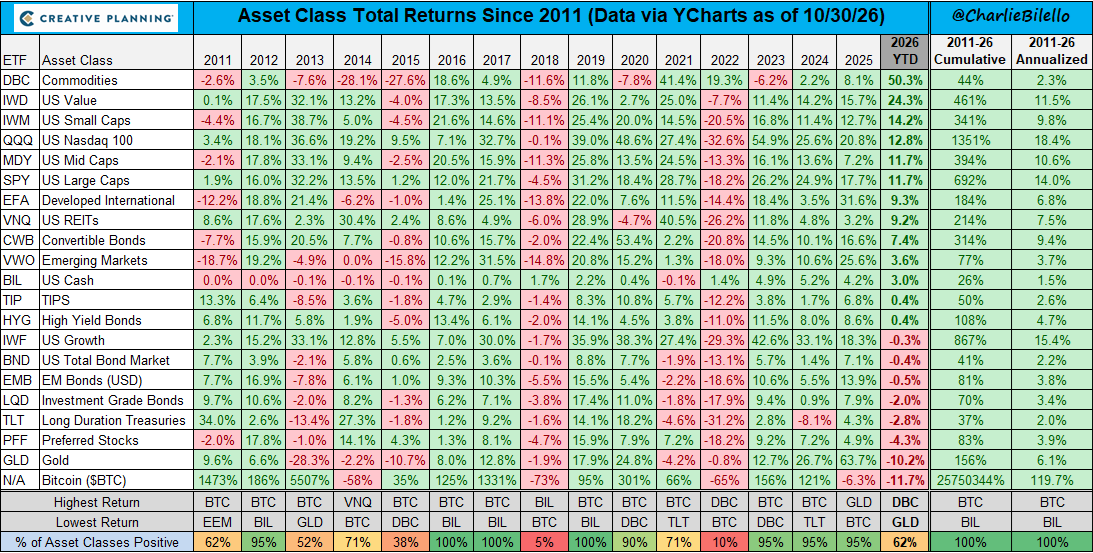
The lack of performance from these hard assets is occurring while the US government is printing more money than ever before. Our national debt interest expense is over $1 trillion annually. And cumulative inflation since 2020 is now over 30%, which continues to destroy the purchasing power of the US dollar.
The mainstream narrative is that bitcoin and gold are not that attractive because of the recent lack of performance. Why own hard assets when you can buy AI stocks that have been white hot for months? Why allocate to non-productive assets like bitcoin and gold when AI companies are producing more revenue and profits than ever before?
The fact that everyone hates these sound money assets is why I like them right now. The unpopular decision will likely be handsomely rewarded over the next 24 months. Investors can’t fight math and the math is telling us the government is going to print trillions of dollars, which will drive hard assets significantly higher during the medium-term.
But bitcoin and gold are not the only counter-trade available right now. My second example is the hardcore AI trade.
Friday was a bloodbath in the market for these companies. Fears related to AI spending continue to apply pressure to public companies, while equally causing issues for private unicorns.
For context, the Nasdaq was down 3.5%. Bitcoin fell even more to below $76,000. Intel and Reddit both dropped like a rock in the ocean. They were down 28% and 29% respectively. Anthropic’s IPO valuation fell from a rumored $2 trillion to about $1.5 trillion and OpenAI cut their fundraising goal from $30 billion to $20 billion.
These are not the headlines you expect to read during an economic boom driven by world-changing technology like AI. People are nervous about the enormous expenses associated with bringing this technology to global adoption. They continue ask whether the ROI will be large enough to have warranted trillions of dollars in spending.
Those are the wrong questions though. You don’t hear the founders of the largest companies in the world talking about AI spending that way. They are discussing it from the exact opposite perspective.
These leaders are instead asking “How much money can we lose if we don’t win the AI race?”
I think that is a much more relevant question. If you lose the AI race for your industry or vertical, you may not be able to catch up in the future. The technology is that distributive. So the analysis shouldn’t center around “what is the ROI?,” but rather “how much are we willing to spend to ensure our business doesn’t go to zero?”
I personally believe the answer for most companies will be “whatever it takes.”
If my assumption and analysis is correct, then the current mainstream narrative around AI spending is completely wrong. The lack of enthusiasm in recent weeks is misplaced and the investors who have the courage to allocate into the weakness will be big beneficiaries in 2027.
Some of you may think the AI trade is over. If that is your view, then you should sell your assets and sit in cash. But almost no one is going to do that because the pain of missing out will be worse than the pain of financial loss.
With that nuance understood, the question becomes “what assets do I allocate to in the AI trade?”
My belief is that a barbell approach will be best suited for most portfolios. First, you want to own as much compute as possible. The world won’t be able to build enough compute, so there is a generational supply/demand imbalance that will drive prices higher over time. At the same time, applied AI and/or physical AI will be one of the largest winners in the next decade.
I am least excited about the general intelligence model labs. Those feel like they are caught in the middle. They don’t own a significant compute business and they don’t own the consumer relationship outside of their monthly subscription fee. This doesn’t mean that the model labs will do poorly, but rather there are significantly better opportunities in compute or applied AI that provide more asymmetry.
So regardless of how you look at the market right now, the two themes I am most excited about for the next decade (AI and bitcoin) are very unpopular right now. This is when fortunes are made by those who can ignore the noise and continue to accumulate ownership of great assets.
Which assets you buy is a deeply personal exercise. You can use Silvia to get personalized insights into your portfolio using cutting-edge AI, including how midterms will affect you, what the optimal tax loss harvesting plan looks like, and where you are getting ripped off by fund fees or other non-obvious expenses.
I will leave you with a clear takeaway: open your eyes, close your ears, and let it rip.
The numbers are the only story that matter. The narratives are wrong. And the market will prove this out in the coming 24 months.
Hope you all have a great start to your week. I will talk to everyone tomorrow.
- Anthony J. Pompliano
Founder & CEO, Silvia, Inc (Nasdaq: SVIA)
Today’s Letter Is Brought To You By Arch Public!

Arch Public just keeps hitting home runs - and the numbers tell the ‘moonshot’ story over and over again. Arch Public equities and ETF tools blow away both buy and hold and DCA returns. Some numbers to consider1:
+ NVDA 523.6%
+ TSLA 129.3%
+ MSTR $260,841 (Cash Yield)
+ MARA $130,147 (Cash Yield)
Both total return and turning high growth, high volatility stocks into cash yield machines are what our warehouse of agentic, algorithmic tools specialize in. And, during our webinar last week, Anthony announced that he has signed up for Arch’s tools and will be using them personally going forward. Take a look at what Arch can do for you, completely hands free with equities, ETF’s, Bitcoin, and crypto. You won’t be disappointed.
Bitcoin Survives Biggest Crypto Hack In History?!
Jordi Visser is a veteran macro investor with 30+ years of experience and the author of the VisserLabs Substack.
In this conversation, we break down the $6 billion Binance hack and what it means for bitcoin, the rise of AI-driven cyber attacks, Anthropic’s S-1, Microsoft’s 60,000-person buyout offer, and Eli Lilly’s record quarter. We also discuss interest rates, the AI bubble debate, and why Jordi believes bitcoin is the purest AI trade.
Podcast Sponsors
Figure – Get up to $1,250 with their Give Thanks, Get Cash promotion. T&Cs apply True DeFi Democratized Prime yielding ~9% APY. They also have the lowest industry interest rates at 8.91% with 12 month terms! Take out a Crypto Backed Loan today. Figure Lending LLC dba Figure (NMLS 1717824)
Arch Public’s platform automates your trading strategy beyond DCA for equities, commodities, ETFs, and crypto. With advanced inputs that reflect your own intentions, Arch Public supports smarter entries, exits, and opportunities in volatile markets. Connect with their team, try the product for free, and see how agentic trading can work for you, with Arch Public!
GalaxyOne – Earn up to 8.00%2 yield on cash. Auto-Reinvest into stock and crypto.
Fitnexa is an AI-powered wellness technology brand. Its SomniPods 3 combine intelligent sleep technology with all-night comfort to support better rest and recovery. Use code POMP10 for $10 off.
Investor Health — Clinician-prescribed protocols for weight, metabolism, and longevity, shipped to your door in 48–72 hours. No office visits. InvestorHealth.com.3
Abra - Bitcoin, two possibilities: explore BTC-backed borrowing or a BTC yield strategy managed by Abra Capital Management. See terms and risks at abra.com/pomp.
Simple Mining offers a premium white-glove Bitcoin mining service. Want to grow your Bitcoin stack? Visit https://www.simplemining.io/pomp
Uphold - Uphold is the all-in-one platform to trade, earn, stake, and swap across 300+ assets with real-time proof-of-reserves and any-to-any conversions. Manage your entire crypto portfolio in one place at www.uphold.com
🚨READER NOTE: If you want to sponsor The Pomp Letter, you can fill out this form and someone from our team will get in touch with you.
You are receiving The Pomp Letter because you either signed up or you attended one of the events that I spoke at. Feel free to unsubscribe if you aren’t finding this valuable. Nothing in this email is intended to serve as financial advice. Do your own research.
The defensive case for AI spending is worth considering, but avoiding disruption and earning an adequate return are different tests. How would you assess when that defensive spending becomes excessive?
"How much are we willing to spend so we don't go to zero" is how a CEO thinks, I believe that. But the CEO doesn't get the last word anymore, because they've run through their own cash.
Last quarter the five biggest spenders put out 116% of their operating cash flow. Amazon was at 182%. Meta sold about $35bn of stock on top of its debt, and S&P just moved its outlook to negative, estimating a shortfall of $39bn this year and $71bn next. On Monday Oracle asked for $20bn and lost 8.8% in a day. "Whatever it takes" now needs someone else's signature.
That matters for your barbell. You want to own as much compute as possible, and on the operating side you have a point. Rent for an AI chip rose from $2.78 to $2.89 an hour since my last count, so there's no glut yet. But look at CoreWeave, which owns exactly that. Rent is rising, yet its 9.625% bonds traded around 79.5 cents in mid-October, about a 15% yield. Compute can be scarce and the equity can still get hurt, if the debt on top reprices first.
So I'd split your second trade in two: compute owned out of cash flow, and compute owned with borrowed money. They look like the same bet right up to the day lenders tell them apart.
I'd also push back a little on "unpopular." The Nasdaq-100 is still up about 22% from its March low, even after this 10% drop. Is that what a hated trade looks like to you?