Today’s Letter Is Brought To You By Fountain Life!

Are you ready to seize the day that will change your life, guaranteed? You invest in wealth creation every day, but what’s the point of it without an optimal healthspan?
Award-winning Fountain Life is the world’s most advanced longevity destination. And in just one day, we use AI-Guided Diagnostics to map an exact and complete picture of your health profile. No guesswork. No blind spots. From there, we create a personalized plan that prevents disease and may even reverse aging by using precision medicine and Restorative Therapeutics, available nowhere else. In other words: Your energy is supercharged, memory sharper, life extended, so that you can live without limits. It’s the best investment you’ll ever make.
Use code POMP and receive $1,000 off the cost of a life-changing membership with Fountain Life when you schedule a call.
To investors,
For most of its early life, Bitcoin was easy to dismiss as a side-show that traded in its own little corner of the financial universe. It moved when it wanted to, crashed when it felt like it, and paid no attention to what the S&P 500, Treasury bonds, oil, or gold were doing. That uncorrelated reputation was a big part of Bitcoin’s appeal to early adopters. Then the world changed and Bitcoin seems to have changed with it.
From 2015 through 2019, Bitcoin’s correlations with every major asset class hovered close to zero. Against the S&P 500, it barely registered at 0.03 to 0.05. Against bonds, oil, and gold, the picture was equally flat. This was Bitcoin in its purest “digital gold” phase, a volatile niche asset largely owned by retail speculators and idealists who weren’t plugged into broader market cycles. When equity markets rallied or sold off, Bitcoin shrugged. The asset existed in a world of its own.
Frankly, it was awesome because bitcoin was as independent as a financial asset can be. That independence wasn’t just a quirk. It made Bitcoin genuinely useful from a portfolio theory standpoint. An asset that moves independently of everything else is valuable precisely because it can reduce overall portfolio risk, regardless of whether it goes up or down. During this period, the correlation argument for holding Bitcoin was actually quite compelling.
The pandemic is where the story gets interesting. COVID-19 broke the correlation spell. When markets crashed in March 2020, Bitcoin got caught in the same liquidation wave that swept through equities, commodities, and credit. Investors needed cash, so they sold everything that was attached to a liquid market. Bitcoin’s correlation with the S&P 500 jumped from near zero to about 0.47 almost overnight.
What followed was arguably more telling. As central banks flooded the system with liquidity and markets recovered, Bitcoin exploded higher. But this seismic move happened in lockstep with the tech-heavy Nasdaq and risk-on equities. The correlation with SPY kept climbing and eventually reached 0.55 to 0.65 between 2021 and 2022.
Bitcoin essentially got absorbed into the macro trade. It was no longer a separate asset class because it evolved into a high-beta version of risk-on sentiment. A new type of investor was holding the asset at this point, which meant that the asset traded much differently.
The approval of spot Bitcoin ETFs in January 2024 was a watershed moment. Bitcoiners and Wall Street institutions were literally celebrating at the achievement of this previously unthinkable milestone. But the Bitcoin bulls should have been careful what they wished for.
Institutional capital flooded in and with it came traditional Wall Street thinking, which meant the differentiation in trading behavior between various assets started to evaporate. Portfolio managers who run models, allocate across asset classes, and rebalance mechanically now owned Bitcoin. That meant when they sold equities, they often sold Bitcoin too. The idealists had essentially lost ground to the mercenary hedge funds.
Today the BTC-SPY correlation sits around 0.49, which is similar to where it ended 2025. Rolling short-term correlations have spiked as high as 0.88 during volatile stretches. Regardless of what your favorite Bitcoin believer tells you, the digital currency is trading like a true risk asset. That’s important for anyone who bought it believing it would zig when stocks zagged. The opposite has happened and correlations only grew stronger.
On the other hand, bonds and oil tell a boring story.
The bonds story is short because there isn’t much of one. We can use TLT as the example. Bitcoin’s correlation with long-duration Treasury bonds has been close to zero throughout its history, sitting at roughly -0.01 today. Bitcoin is a risk-on asset and bonds are risk-off, but the relationship is too inconsistent and too weak to use strategically.
Oil has followed a similar trajectory. Binance Research’s 10-year study found no significant long-term relationship between Bitcoin and crude prices. Short-term spikes occur, but they snap back. The long-run correlation remains around 0.15, which is weak enough to be effectively meaningless.
The gold relationship is where things have gotten genuinely strange in 2026. Through most of its history, Bitcoin carried a small positive correlation with gold, typically between 0.10 and 0.35. The idea was these two assets reflected shared sensitivity to dollar weakness and inflation fears. That narrative fueled years of “digital gold” marketing. But just look at this chart:
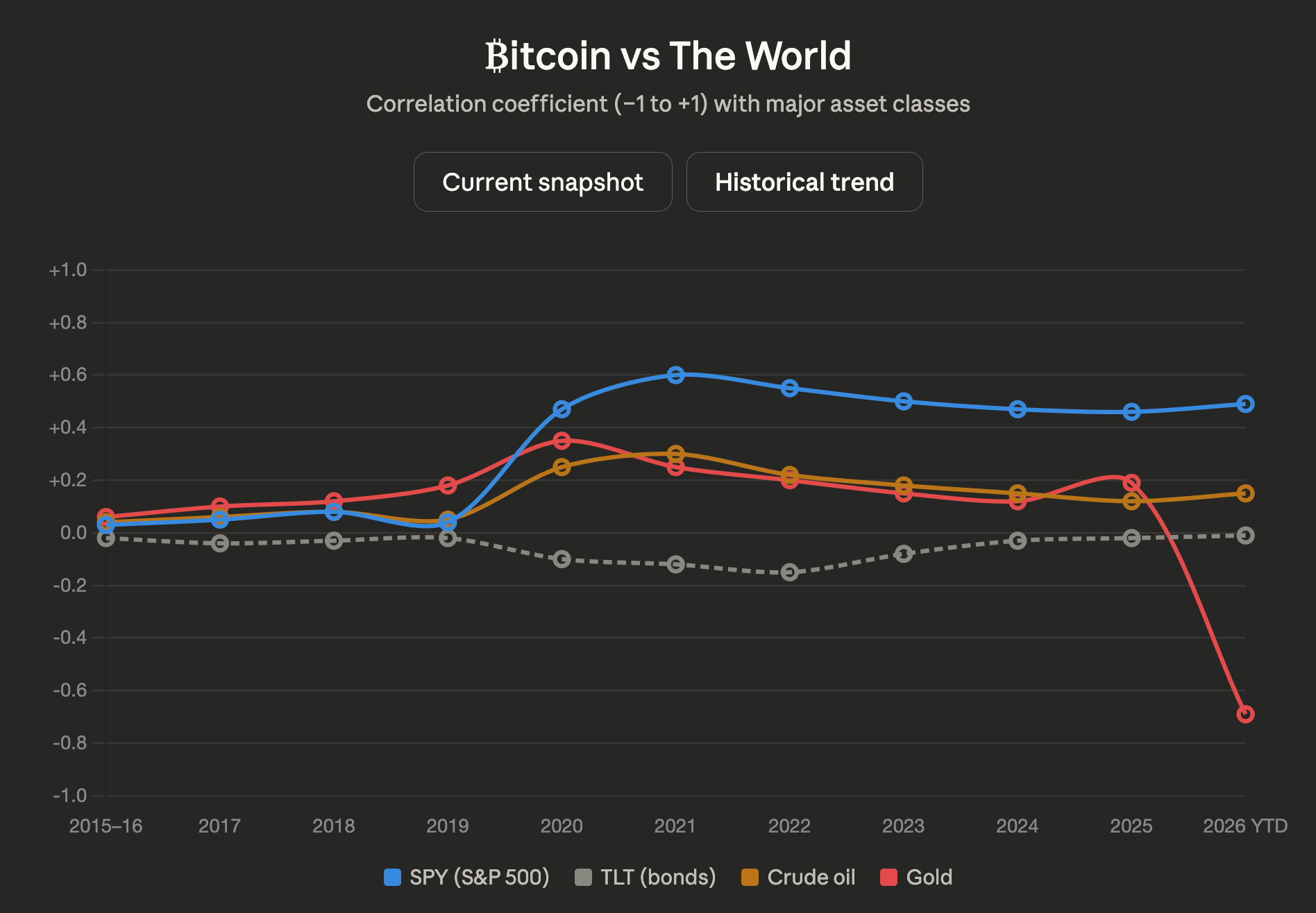
Bitcoin’s correlation with gold has fallen apart. Gold had surged higher as a geopolitical safe haven last year, while Bitcoin sold off. This meant the two assets were moving in almost opposite directions. This marked one of the only times in history these two store-of-value assets had a negative correlation.
The trend has only continued this year. The BTC-gold correlation is -0.69 right now, which is the sharpest divergence on record. The only difference is that since the February 28th bombing of Iran, gold has been selling off and bitcoin has been appreciating in price. Even though these assets switched their direction of travel, the negative correlation still persists.
So what can we take away from this data?
First, Bitcoin has grown up and been adopted by larger pools of capital. This newfound investor base doesn’t discriminate. They have pulled Bitcoin into the risk-on / risk-off regime they are used to navigating. Bitcoin is simply along for the ride now.
Bitcoin has become more integrated with the financial system. It is more responsive to macro conditions. And unfortunately, Bitcoin is considerably less useful as a diversifier. Whether that’s a feature or a bug depends entirely on what you wanted it to be.
There will always be hardcore Bitcoin believers that will never sell the asset, regardless of what happens in the market. But I am more convinced every day that a lot of the Bitcoin selling from OGs last year was driven by people realizing the renegade asset they once bet their net worth on is gone. What is left is a slightly more volatile digital currency that hopes to continue pulling in more capital in the coming years.
Have a great end to your week. I will talk to everyone on Monday.
- Anthony J. Pompliano
Founder & CEO, Professional Capital Management
🚨Webinar: Learn How To Use Bitcoin in Tax-Advantaged Accounts

Join myself and Chris Kline for a FREE live webinar on how the right tax structure can change your financial life.
We’ll cover Bitcoin’s role in a modern portfolio, tax-advantaged account strategies, and what investors should be thinking about right now.
Learn about:
✅ How taxes quietly destroy wealth
✅ The accounts high earners actually use
✅ Live Q&A with Pomp
Don’t miss the opportunity to get your questions answered directly by myself and Chris Kline!
CFTC Chairman Reveals America’s New Plan For Bitcoin & AI
Mike Selig is the 16th Chairman of the CFTC and a leading voice on the future of financial market regulation in an era defined by crypto, artificial intelligence, and prediction markets.
In this conversation, we discuss how regulators are balancing innovation with investor protection, the evolving relationship between the SEC and CFTC, and why emerging technologies are reshaping how risk is taken and managed across global markets. We also explore the rise of decentralized finance, AI-driven trading, and new policy initiatives aimed at keeping the United States competitive in the next generation of financial infrastructure.
Podcast Sponsors
Figure – True DeFi Democratized Prime to earn ~9% APY! They also have the lowest industry interest rates at 8.91% with 12 month terms! Take out a Bitcoin Backed Loan today and buy more Bitcoin. Check out Figure! Figure Lending LLC dba Figure. Equal Opportunity Lender. NMLS 1717824. Terms and conditions apply.
Arch Public - Arch Public’s cutting-edge algorithmic tools ignite profits, harnessing razor-sharp data analytics to nail perfect entries, exits, and risk management. Turn volatility into opportunity and do it hands free with Arch Public. (Oh, and yes, try us out for FREE too!)
BitcoinIRA - Buy, sell, and swap 80+ cryptocurrencies in your retirement account. Pay less taxes. Earn up to $2,000 in rewards.
Award-winning Fountain Life - Energy supercharged. Memory sharper. Life extended. Ready for the best investment you’ll ever make? Schedule a life-changing call at www.FountainLife.com
Summ – (formerly Crypto Tax Calculator) generates accurate IRS-ready tax reports that help maximize deductions and pay the least tax possible. With support for 3,500+ exchanges, wallets, and protocols, Summ makes crypto taxes simple. Visit Summ.com and get 20% off with code POMP20.
Bitget - Bitget is the world’s largest Universal Exchange (UEX), serving over 125 million users with access to over 2M+ crypto tokens, and TradFi markets such as 100+ tokenized stocks, ETFs, commodities, FX and precious metal like Gold.
Abra - This podcast is sponsored by Abra. Abra is the secure way to access crypto and crypto based yield and loan products through a separately managed account. To create an account, click here for individuals and here for entities.
Simple Mining offers a premium white-glove Bitcoin mining service. Want to grow your Bitcoin stack? Visit https://www.simplemining.io/pomp
🚨READER NOTE: If you want to sponsor The Pomp Letter, you can fill out this form and someone from our team will get in touch with you.
You are receiving The Pomp Letter because you either signed up or you attended one of the events that I spoke at. Feel free to unsubscribe if you aren’t finding this valuable. Nothing in this email is intended to serve as financial advice. Do your own research.