
Are Stablecoins Saving The Treasury Market?
Today’s letter is brought to you by Dream Startup Job!

Dream Startup Job is the premier marketplace for connecting ambitious job-seekers with the world's most innovative companies.
Search over 1,000 roles and apply quickly to cutting-edge companies like Traba, Varda, Eight Sleep, Flowhub, and many others.
If you're looking to join a team that is making a difference in the world, create a job-seeker profile in minutes and start applying for roles.
If you're a startup, post your open roles today or schedule a call with the Dream Startup Job team by clicking here.
To investors,
US bonds have historically been seen as a safe haven asset, but in a time when investors were seeking safety, bonds have failed them.
The iShares 20 Plus Year Treasury Bond ETF ($TLT) is down 22% over the last 5 years and down almost 50% since the high of 2020.
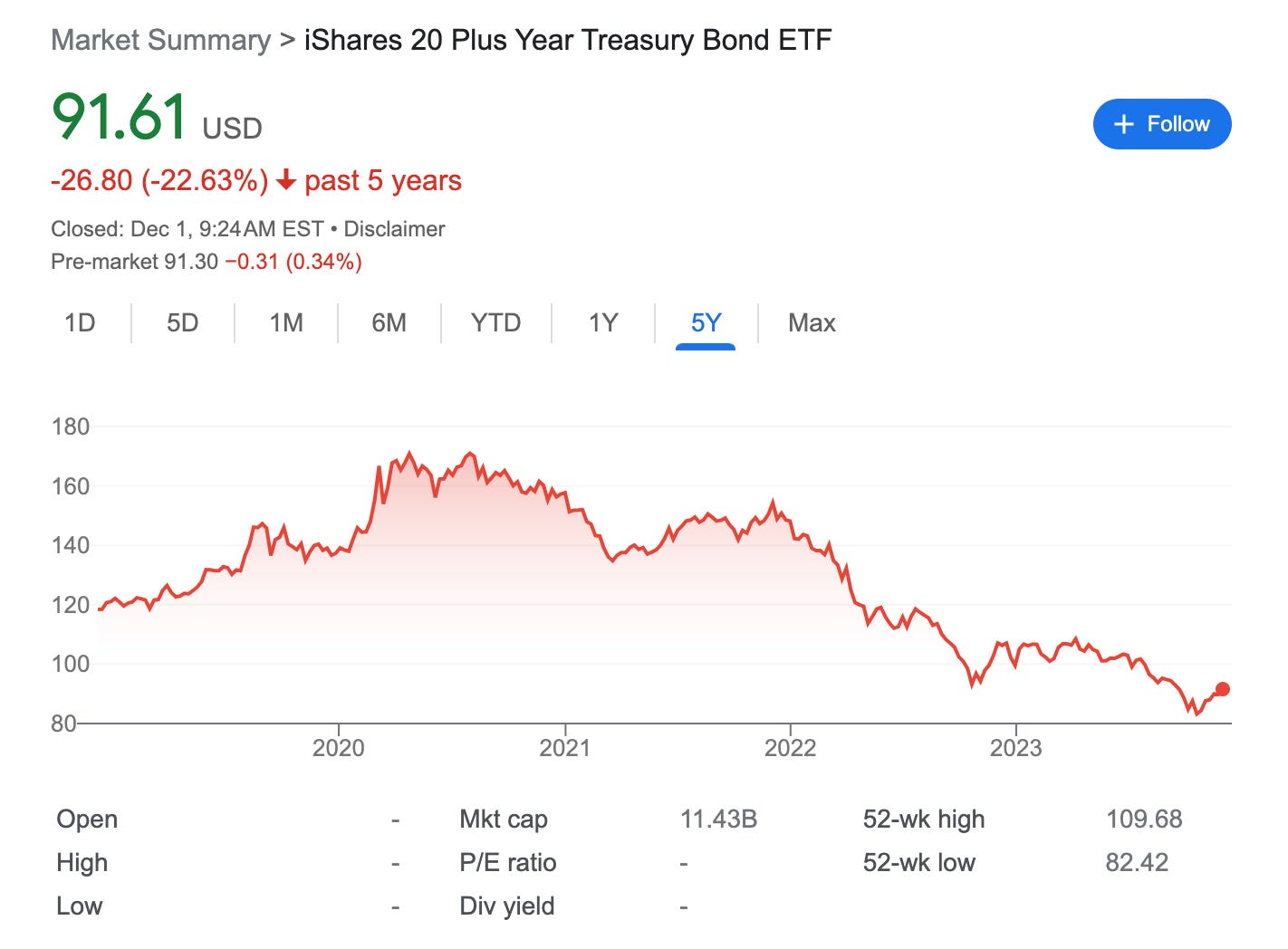
This is a disaster, but why is it happening? Simple — there is an imbalance in supply and demand.
Liz Hoffman writes for Semafor:
“Nobody wants U.S. Treasury bonds.
Once a symbol of America’s economic might and accepted as a global coin of the realm, they have fallen badly out of favor, with serious consequences for taxpayers, investors, and financial markets.
Elementary economic forces — too much supply and not enough demand — have collided to create the worst stretch for U.S. government bonds since the Civil War. The government keeps borrowing to cover its budget deficits, while once-reliable buyers of that debt, both at home and abroad, have pulled back.
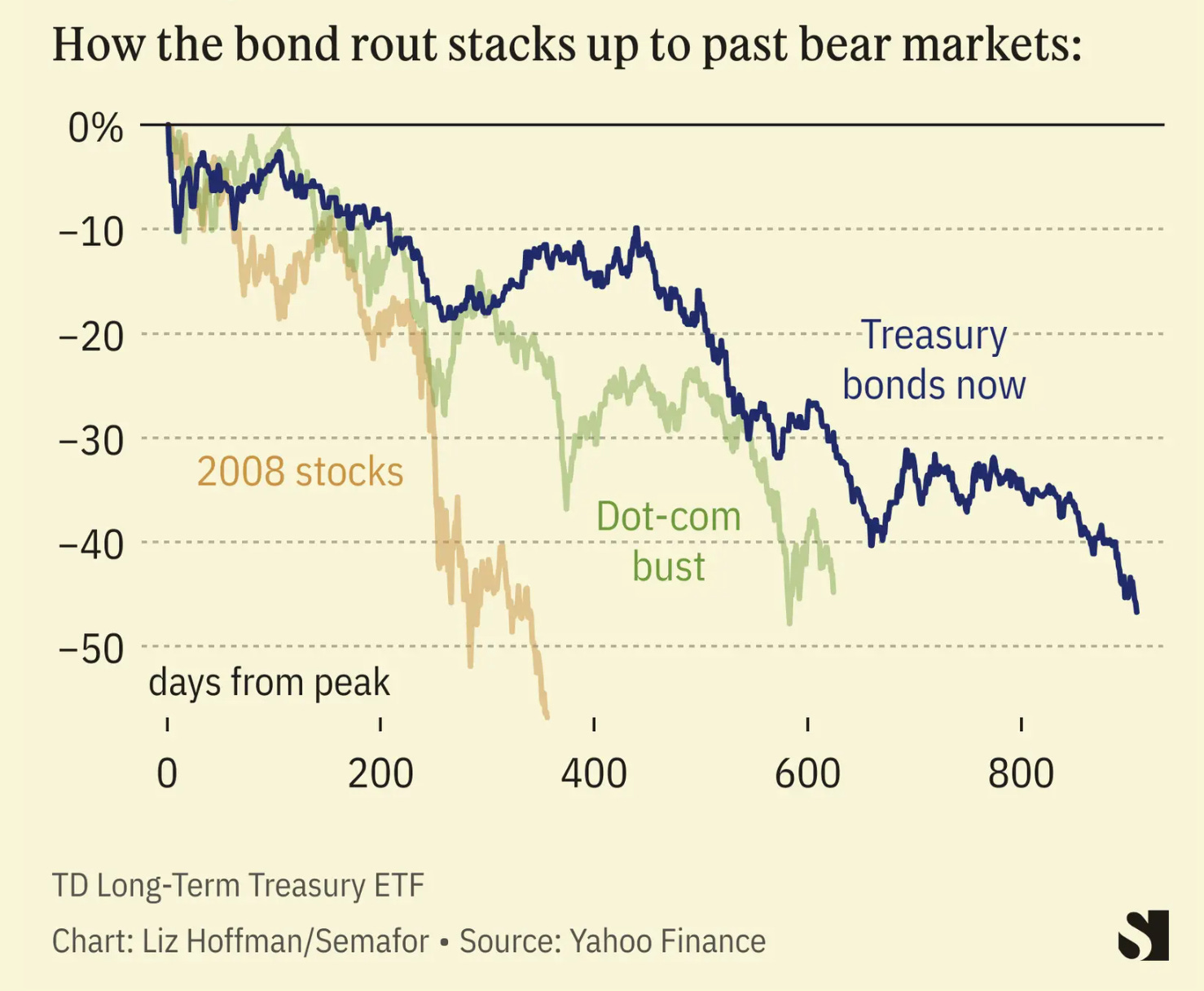
The result: Investors are demanding the steepest yields since 2007. Auctions of fresh bonds that were once routine are now going terribly. And bond portfolios are getting absolutely hammered. The longest-dated Treasury bonds are in a bear market worse than the dot-com bust and almost as bad as 2008.”
That sounds bad, right? It looks even worse when you visually show it on a chart:
Hoffman goes on to share an even more damning data point:
“Already running huge deficits, the only way for Treasury to pay the interest — along with ambitious spending programs like the CHIPS Act and student-loan forgiveness — is to keep borrowing.
But from whom?
China and Japan, once reliable buyers of Treasury bonds, have been selling them to prop up their weakening currencies. A decade ago they held more than 22% of U.S. government bonds; today it’s 7%.”
Think about that for a second. China and Japan have decreased their share of US Treasuries by approximately 68% over the last 10 years. Not a great situation.
Thankfully, at the same time that nation states have been decreasing purchases in US Treasuries, another buyer has shown up in the market. It isn’t the buyer you would expect though.
Stablecoin issuers are buying US treasuries by the handful. They have collectively become the 16th largest holder of treasuries, and as CoinFund’s Chris Perkins pointed out, hold more than Norway, South Korea, Saudi Arabia, Germany, The Netherlands, Mexico and the UAE.
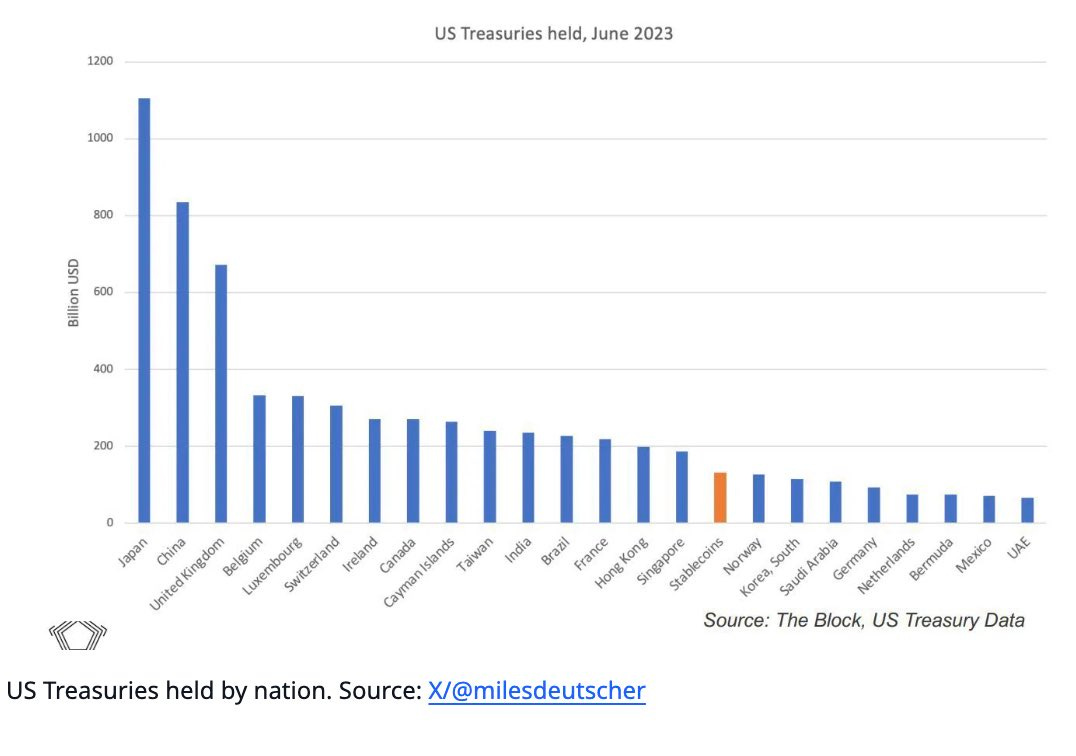
The dichotomy is noteworthy. Nation states with fiat currencies have decreasing interest, while digital fiat currencies are increasing. This is a true digital disruption, although it is widely misunderstood by most market participants.
Japan and China are not going to stop holding treasuries though. The two countries remain the largest holders globally by a far margin. Investors should pay attention to the trend, rather than the static state of the current situation. As Wayne Gretzky said, skate to where the puck is going.
And that puck seems to indicate the future will be dominated by fiat stablecoin issuers holding a significant amount of US treasuries. In fact, there is a serious chance that over the next 10-15 years, stablecoin issuers could become the single largest holder of treasuries in the world.
While that may seem far-fetched today, it would have been impossible to predict the rapid rise of these assets just 5 years ago. Disruption happens fast. Bill Gates said it best — we overestimate what we can accomplish in one year but underestimate what we can accomplish in 10 years.
Let’s see what happens. Hope you all have a great end to your week. I’ll talk to everyone tomorrow.
-Anthony Pompliano
If you enjoyed this letter, you should consider subscribing to the Pomp Letter. I write 3-5x per week and explain in simple language what is happening in the economy, financial markets, and bitcoin.

Bradley Tusk is a venture capitalist, political strategist, writer, and owner of P&T Knitwear bookstore.
In this conversation, we talk about his brand new book, called “Obvious in Hindsight.” It is all about a fictional story of innovative technology, flying cars, and what they have to go through with politicians, mafia members, etc. This is a great conversation about how technology meets politics, and the reality on the ground.
Listen on iTunes: Click here
Listen on Spotify: Click here
Earn Bitcoin by listening on Fountain: Click here
Bradley Tusk On How Startups Can Beat Politicians & Regulations
Podcast Sponsors
Cal.com - Changing the calendar management game. Use code “POMP” for $500 off when you sign up.
Trust & Will - Estate planning made easy. They are fast, secure, and simple to use. Get your will or trust created today.
Auradine - A new bitcoin miner powered by the world’s first 4 nanometer silicon chip technology.
Base: Base is shaping the future of the on-chain world with near-zero gas fees and rapid transaction speeds.
ResiClub: Your data-driven gateway to the US housing market.
Bay Area Times: A visual newsletter explaining the latest tech & business news.
You are receiving The Pomp Letter because you either signed up or you attended one of the events that I spoke at. Feel free to unsubscribe if you aren’t finding this valuable. Nothing in this email is intended to serve as financial advice. Do your own research.
I simply call em like I see em.
Does it mean that Tether USDT its hedging bond risk by buying Bitcoin?